
2026 commodity prices face continued moderation
Global commodity prices are projected to decline by about 7 percent in 2026, marking the fourth consecutive year of moderation. According to the World Bank Group's latest Commodity Markets Outlook, this decline pushes prices toward their lowest level in six years. The global economy is shifting from the high-inflation pressures of the post-pandemic era into a phase of normalized supply and demand dynamics.
The US dollar plays a pivotal role in this trajectory. As the primary currency for most global commodity transactions, a strengthening or stable dollar exerts downward pressure on prices denominated in other currencies. This dynamic limits the upside potential for raw materials, even as specific sectors like energy and metals experience distinct, localized volatility driven by geopolitical tensions and industrial demand.
The Bloomberg Commodity Index reflects this broader trend of consolidation. While short-term spikes occur due to supply chain disruptions or weather events, the underlying trend remains anchored by ample global inventories and subdued macroeconomic growth in key manufacturing hubs. Investors and producers alike are navigating a landscape where broad-based price surges are rare, and margin management is critical.
This environment favors efficiency over speculation. With broad price increases unlikely, success in 2026 will depend on identifying specific commodities where structural deficits or strategic reserves create value, rather than betting on a general inflationary rally.
AI reshaping supply chain resilience
Artificial intelligence is no longer confined to experimental pilots in commodity trading. By 2026, major firms have integrated predictive logistics into their core operations, treating data as a physical asset alongside the metals and energy they trade. This shift is moving the industry from reactive firefighting to proactive risk mitigation, allowing traders to navigate volatility with greater precision.
Predictive logistics uses machine learning to analyze weather patterns, port congestion, and geopolitical tensions in real time. Instead of waiting for delays to occur, algorithms forecast disruptions days or weeks in advance. This capability is particularly vital for transition metals and LNG, where supply chains are increasingly complex and fragile. Companies that adopt these systems can reroute shipments and adjust inventory levels before a bottleneck affects their bottom line.
Risk mitigation has also evolved beyond traditional hedging. AI models now simulate thousands of market scenarios to identify potential failures in supply chains. These simulations help traders understand how a single point of failure, such as a canal closure or a mine strike, might cascade through their portfolio. By stress-testing their operations against these digital twins, firms can build more resilient networks that withstand shocks without significant financial loss.
The integration of these technologies is reshaping how commodity houses operate. As energy trading firms diversify into transition metals and oil majors pivot to LNG, the ability to manage complex, global supply chains becomes a competitive advantage. Firms that fail to adopt predictive AI risk falling behind in an environment where speed and accuracy are paramount.
Energy transition metals take center stage
The global shift away from fossil fuels is rewriting the rules of the commodity market. While traditional energy prices face downward pressure, demand for transition metals—specifically copper, lithium, and nickel—is accelerating. This divergence creates a complex landscape where infrastructure build-outs for renewable energy and electric vehicles (EVs) drive structural deficits, contrasting sharply with the cyclical nature of oil and gas.
| Metal | Primary 2026 Use | Demand Driver | Volatility Trend |
|---|---|---|---|
| Copper | Electrical wiring & grids | EVs & renewable infrastructure | High |
| Lithium | EV battery cathodes | Battery storage scaling | Very High |
| Nickel | Stainless steel & batteries | High-nickel battery chemistry | Moderate |
| Oil (Brent) | Transportation fuel | Global GDP & OPEC+ policy | High |
Copper remains the backbone of electrification. Every EV requires roughly four times more copper than a conventional vehicle, and renewable energy systems like wind and solar are even more material-intensive. As grid modernization projects accelerate in 2026, supply constraints from aging mines are likely to keep copper prices elevated, making it a critical indicator of green energy adoption rates.
Lithium and nickel face different dynamics. Lithium prices have corrected significantly from their 2022 peaks, but 2026 demand is expected to surge as battery production scales to meet EV targets. Nickel’s role is split between stainless steel and battery applications, with the latter becoming increasingly vital as manufacturers push for higher energy density. These metals are not just commodities; they are the physical inputs for the energy transition itself.
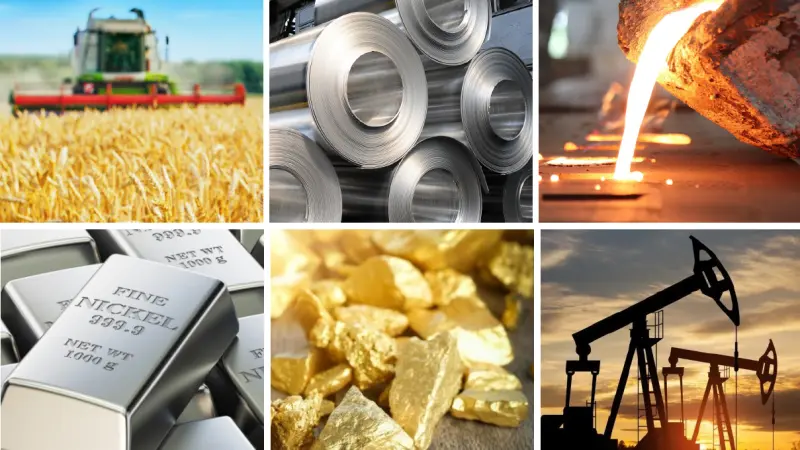
Tracking these metals requires real-time data. Unlike oil, which is heavily influenced by geopolitical events and OPEC decisions, transition metals are driven by industrial production cycles and technological adoption rates. Investors and analysts must monitor mining output, battery manufacturing capacity, and government policy incentives to gauge future price movements.
Precious metals and dollar dynamics
The inverse relationship between the US dollar and precious metals remains the dominant force in 2026 commodity markets. As the dollar trends lower, gold and silver act as primary leadership areas, reflecting their role as hedges against currency debasement and inflation. This dynamic is not merely theoretical; it is currently driving significant capital flows into bullion assets.
Gold continues to demonstrate resilience, supported by central bank accumulation and geopolitical uncertainty. The weakening dollar makes gold cheaper for holders of other currencies, boosting international demand. Meanwhile, silver is benefiting from both its monetary history and industrial demand, creating a dual engine for price appreciation.
Outlook for 2026 suggests continued strength for both metals. Silver, in particular, is viewed as having significant upside potential, with some analysts pointing to the possibility of reaching new highs if industrial demand remains robust alongside monetary hedging. The convergence of a weaker dollar and strong metal fundamentals creates a favorable environment for precious metals investors.
Key questions on 2026 market outlook
Investors are weighing conflicting signals for 2026: a broad decline in global commodity prices against specific strength in precious metals. The World Bank projects a 7 percent drop in global commodity prices this year, marking the fourth consecutive year of moderation World Bank, 2025. This general downward pressure sets a cautious tone for industrial inputs, yet it does not dictate the trajectory of every asset class.
Precious metals, particularly silver and gold, are bucking the broader trend. Analysts note that these metals continue to act as leadership areas as the US dollar trends lower Specialist Share Education. Silver’s potential to reach significant price milestones is driven by a convergence of industrial demand and monetary policy shifts, creating a distinct divergence from the wider commodity complex.
No comments yet. Be the first to share your thoughts!