
Structural shifts define the 2026 outlook
The 2026 commodity landscape is defined by a fundamental structural transformation rather than a standard cyclical recovery. As noted by Interactive Brokers, this year’s outlook diverges sharply from historical norms. Supply across metals has become more constrained, concentrated, and politicised, while demand is increasingly dictated by electrification mandates and strategic institutional behaviour rather than pure industrial cycles.
This divergence is already visible in price performance. Oxford Economics projects that metals will outperform other commodity sectors in 2026, while energy and agricultural commodities are set to weaken on average. This split highlights a market where traditional correlations are breaking down. Investors can no longer rely on broad basket exposure; the alpha lies in identifying which specific metals are insulated by supply bottlenecks and which are vulnerable to softer global growth.
The World Bank’s October 2025 Commodity Markets Outlook reinforces this caution, projecting that global commodity prices will decline to their lowest level in six years in 2026. This marks the fourth consecutive year of decline, suggesting that the "soft landing" narrative for raw materials may be overstated. However, this broad decline masks significant underlying strength in critical transition metals. The structural floor for metals is rising even as the broader commodity index falls.
The implication for 2026 is clear: volatility will be driven by structural mismatches, not just macroeconomic sentiment. A strategy that worked in 2023 or 2024 may fail in 2026 because the underlying drivers have shifted from growth optimism to supply security. Understanding this structural floor is essential for positioning portfolios ahead.
Green metal supply chains tighten
The defining feature of the 2026 commodity landscape is a structural transformation where supply has become more constrained, concentrated, and politicized, while demand is increasingly shaped by electrification and strategic investment. This divergence creates a "green metal shortage" narrative that is distinct from broader cyclical recovery. While the World Bank projects that aggregate commodity prices may fall to their lowest level in six years due to general macroeconomic headwinds, this broad decline masks a critical fracture in the energy transition metals sector.
Copper and lithium remain the primary fault lines in this tightening market. Copper, the backbone of electrical grids and renewable infrastructure, faces a persistent deficit as mine development timelines stretch beyond standard cycles. Simultaneously, lithium carbonate prices, having corrected sharply from their peaks, are now testing the floor of production costs for high-cost producers. This creates a volatile environment where short-term price weakness coexists with long-term supply insecurity. The market is no longer driven by simple inventory cycles but by the geopolitical reality of securing critical inputs.
The disparity between general commodity trends and green metal fundamentals is stark. Broad indices may reflect a cooling global economy, but the specific demand from the energy transition continues to outpace supply expansion for critical minerals. This structural imbalance means that volatility in copper and lithium will likely remain elevated, driven by policy shifts and supply chain reconfigurations rather than traditional industrial demand signals.
This divergence underscores the need for investors to look beyond broad commodity indices. The supply constraints in green metals are not temporary blips but structural shifts that will define the market regime for the coming years. As policy support for decarbonization accelerates, the gap between available supply and required demand for these critical minerals is expected to widen, keeping pressure on supply chains and pricing mechanisms.
Energy and agriculture face headwinds
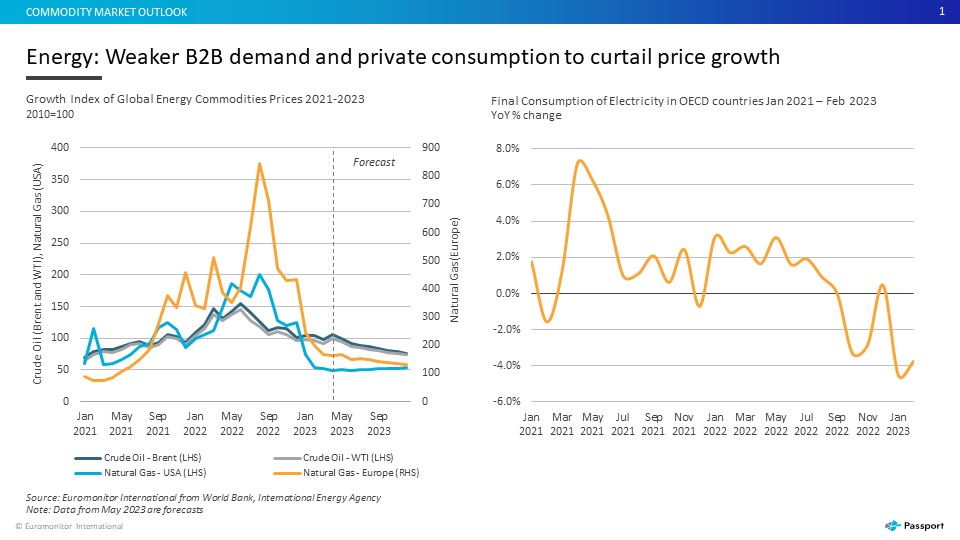
While metals are poised for structural strength, energy and agricultural commodities are bracing for a difficult year. The World Bank’s October 2025 Commodity Markets Outlook projects that global commodity prices will decline to their lowest level in six years in 2026, marking the fourth consecutive year of decline. This broad-based weakness stems from slowing global growth and a normalization of supply chains that have been tight for the past few years.
For energy, the primary headwind is the expectation of subdued demand growth against a backdrop of steady supply. Oil markets are struggling to find upward momentum as economic indicators in major economies point to slower industrial activity. Similarly, agricultural commodities are facing pressure from improved harvest yields and reduced logistics bottlenecks, which have alleviated the supply shocks that drove prices higher in previous cycles.
The divergence is stark when comparing sector performances. Metals, driven by electrification and constrained supply, stand in sharp contrast to the energy and agri-commodities sectors, which are caught in a cycle of excess supply and weak demand. Investors should expect this gap to widen as the year progresses, with capital rotating away from traditional commodity inputs toward strategic metals.
| Sector | 2026 Outlook | Primary Driver | Key Risk |
|---|---|---|---|
| Metals | Strong | Structural supply constraints | Demand shock from China |
| Energy | Weak | Normalized supply | Geopolitical disruption |
| Agriculture | Weak | Improved harvest yields | Weather volatility |
This split requires a nuanced approach to portfolio allocation. Broad commodity exposure may mask the underperformance of energy and agriculture, so selective positioning is essential. As noted by UBS, commodities still offer attractive returns for diversification, but the beta is shifting toward metals and commodity-linked equities rather than broad indices.
Trade policies and strategic stockpiling fragment global flows
The era of frictionless global trade is giving way to a fragmented landscape defined by tariffs, export controls, and strategic stockpiling. This structural shift is no longer just about supply and demand; it is a geopolitical recalibration that adds a persistent risk premium to physical assets. As nations prioritize energy security and critical mineral independence, the arbitrage opportunities that once smoothed out price discrepancies are disappearing.
Trade barriers are actively reshaping commodity corridors. The World Bank projects that global commodity prices will decline to their lowest level in six years in 2026, marking the fourth consecutive year of decline. However, this broad macroeconomic trend masks significant volatility driven by policy shocks. While bulk commodities may face downward pressure from slowing global growth, politically sensitive metals like copper, lithium, and uranium are decoupling from traditional cycles. Their prices are increasingly determined by the speed of government procurement and the tightening of export regulations rather than pure industrial demand.
Strategic stockpiling has become a primary driver of market tightness. Governments are not merely reacting to shortages; they are preemptively accumulating reserves to insulate their economies from external shocks. This institutional behavior creates a floor for prices in critical sectors, reducing the liquidity available to private traders and increasing the cost of carry. The result is a market where physical availability is more valuable than paper contracts, and where the cost of logistics includes a significant insurance premium against policy uncertainty.
This fragmentation forces investors to look beyond simple supply-demand charts. The risk is no longer just about production capacity, but about the political will to restrict or redirect flows. As trade policies harden, the distinction between domestic and global markets blurs, creating localized premiums that can persist for years. In this environment, holding physical exposure to politically secure jurisdictions offers a hedge against the very policies that are driving the fragmentation.
No comments yet. Be the first to share your thoughts!