
The 2026 commodity price forecast
The global commodity market is entering a phase of sustained downward pressure. According to the World Bank’s April 2026 Commodity Markets Outlook, prices are projected to decline by 5 percent in 2025 and continue falling by an additional 2 percent in 2026. This marks the fourth consecutive year of declining prices, a trend driven primarily by softer oil markets and subdued global demand.
While energy costs are the main drag on the index, the broader market reflects a cooling economy. Subdued industrial activity in key manufacturing hubs has reduced the appetite for industrial metals and agricultural products. This fragmentation means that even sectors with strong long-term fundamentals, such as green metals, are not immune to the current macroeconomic headwinds.
Geopolitical tensions remain a wildcard. While supply disruptions could theoretically spike prices, the current oversupply in energy markets and reduced demand elasticity are acting as a buffer. Traders are monitoring these dynamics closely, as a sudden shift in trade policies or regional conflicts could alter the trajectory of this multi-year decline.
Green metal price dynamics
Green metals are the quiet engine of the energy transition, but their markets are currently defined by volatility. Lithium, cobalt, and nickel face a complex tug-of-war between long-term decarbonization mandates and short-term supply chain reconfigurations. As of 2026, price signals are no longer just about scarcity; they are about geopolitical alignment and processing capacity.
Lithium remains the most sensitive indicator of EV demand. Prices have corrected sharply from 2022 peaks as new supply from Australia and South America came online faster than demand growth. However, the floor is holding as lower-cost producers adjust output. The market is shifting from a pure volume play to one focused on battery-grade purity and regional proximity to manufacturing hubs.
Cobalt and nickel are navigating a different path. Nickel is seeing a structural shift toward Class 1 (high-purity) supply for batteries, while Class 2 (industrial) grades face oversupply. Cobalt prices are increasingly tied to recycling streams and ethical sourcing policies in the DRC, which are reshaping traditional supply chains. These metals are becoming less about raw extraction and more about secure, compliant processing.
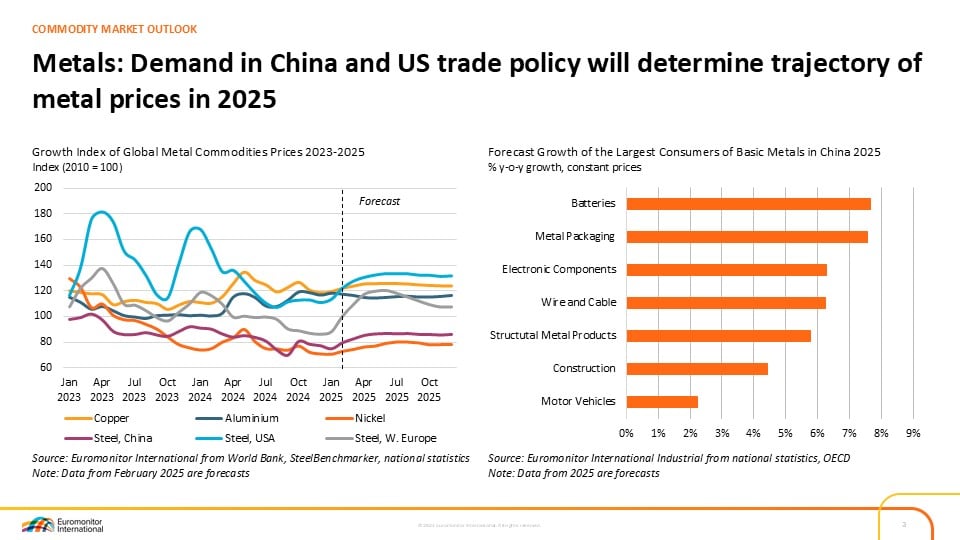
Policy is the new price driver. Tariffs, local content requirements, and carbon border adjustments are fragmenting the global market. Buyers are willing to pay a premium for metals sourced from allied nations with transparent labor and environmental standards. This "friend-shoring" trend is creating regional price disparities that will persist through the decade.
The outlook for green metals is not linear. While the long-term demand curve remains steep, short-term fluctuations will be driven by inventory cycles and policy implementation speeds. Investors and manufacturers must track not just tonnage, but the geopolitical map of supply chains. The value of these metals lies in their reliability and compliance as much as their chemical properties.
| Metal | Primary Risk | Key Price Driver |
|---|---|---|
| Lithium | Supply glut from new mines | EV adoption rates & battery tech shifts |
| Nickel | Class 1 vs. Class 2 oversupply | Battery-grade purity standards |
| Cobalt | Geopolitical instability in DRC | Recycling volume & ethical sourcing |
Balancing policy risk with long-term demand
Institutional investors are recalibrating their commodity allocations for 2026, moving capital toward the materials that underpin the energy transition. The strategy is no longer binary; it involves balancing the immediate volatility of policy shifts against the structural, decades-long demand for clean energy inputs. As S&P Global notes, 2026 will be shaped by the complex interplay of supply-demand dynamics and geopolitical friction, requiring a nuanced approach to risk management.
The core tension lies in the difference between fossil fuel commodities and green metals. Traditional energy assets offer immediate cash flow but face increasing regulatory headwinds and carbon pricing. Green metals like copper and lithium promise long-term growth driven by electrification, but their supply chains are currently constrained by permitting delays and geopolitical concentration. Investors must weigh the certainty of current fossil fuel demand against the potential, yet unproven, scale of the green metal market.
To navigate this divergence, asset allocators are comparing risk and return profiles side-by-side. The following table highlights the contrasting characteristics of these two commodity classes for the 2026 outlook.
| Commodity Class | Primary Driver | Policy Risk | Supply Constraint |
|---|---|---|---|
| Fossil Fuels | Immediate energy demand | High (carbon taxes, regulations) | Moderate (geopolitics, capex cycle) |
| Green Metals | Electrification & efficiency | Low (subsidies, incentives) | High (mining permits, concentration) |
This comparison underscores why a diversified approach is essential. Relying solely on green metals exposes portfolios to supply chain bottlenecks that can delay projects for years. Conversely, staying exclusively in fossil fuels ignores the inevitable decline in long-term demand as the energy mix shifts. The most resilient 2026 portfolios will likely maintain a core position in traditional energy while strategically increasing exposure to the critical minerals that power the next generation of infrastructure.
Geopolitical shocks and supply risks
Use this section to make the Commodity Trends decision easier to compare in real life, not just on paper. Start with the reader's actual constraint, then separate must-have requirements from details that are merely nice to have. A practical choice should survive normal use, maintenance, timing, and budget. If a recommendation only works in an ideal situation, call that out plainly and give the reader a fallback path.
The simplest way to use this section is to write down the must-have criteria first, then compare each option against those criteria before weighing nice-to-have features.
No comments yet. Be the first to share your thoughts!